“WHEN IN THE COURSE OF HUMAN EVENTS, IT BECOMES NECESSARY…”
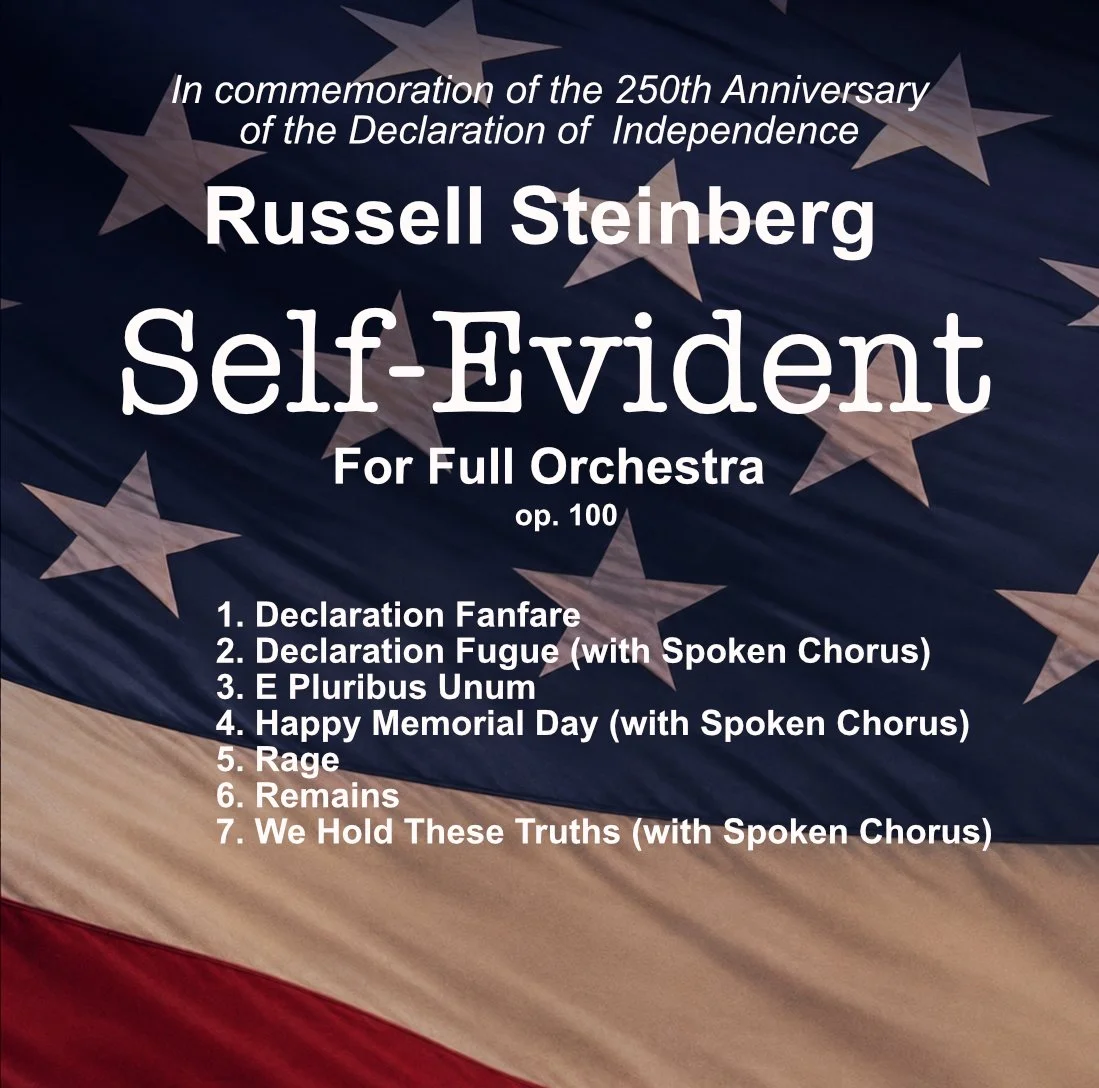
Duration: 25 minutes in 7 movements
Movements:
1. Declaration Fanfare
2. Declaration Fugue (with Spoken Chorus)
3. E Pluribus Unum
4. Happy Memorial Day (with Spoken Chorus)
5. Rage
6. Remains
7. We Hold These Truths (with Spoken Chorus)
Instrumentation:
picc/2fl/2ob/2cl Bb/2 bsn/2 hn/3 tpt/3 tbn/tba/timp/4 perc—snare, bd, crash and susp. cym, tri, tamb, glock, xylo/strings
ABOUT SELF-EVIDENT…
I envisioned Self-Evident as a response to our current perilous political climate, inspired by the searing phrases of our Declaration of Independence, at its 250th anniversary. I imagined the orchestra not only playing the rhythms and accents in those phrases, but literally speaking them and swirling them around in three part spoken chorus.
Video from Carnegie Hall Performance June 23, 2026
Movements 1, 2, 3, 7
Videos from performance April 20, 2026 concert at Ambassador Auditorium
Movements 1, 2, 3, 5, 6, 7
Self-Evident 1. Declaration Fanfare
Self-Evident 5. Rage
Self-Evident 2. Declaration Fugue
Self-Evident 6. Remains
Self-Evident 3. E Pluribus Unum
Self-Evident 7. We Hold These Truths
SELF-EVIDENT… is in 7 movements:
Movement 1 Declaration Fanfare begins with the trumpet sounding a fanfare motto that is the source for the entire work. The motto wavers between the two notes D and D sharp. They represent for me the conflict implicit in the Declaration, of whether or not we can attain its bold and original ideals. Whether we the many can agree as one on equality for all, and government that serves rather than rules us.
Movement 2 Declaration Fugue divides the orchestra into a 3 part spoken chorus to perform a 3 part fugue on the Declaration’s introduction. (I was inspired by Ernst Toch’s marvelous 4 part spoken Geographical Fugue). Hearing these familiar words spoken contrapuntally revitalizes their profound energy and daring.
Movement 3 E Pluribus Unum (from the many, one), is quite literal. A large sound mass compresses to a single tone (the note E, a “solution” to the conflict of D and D sharp?) that then dissolves in a tug-of-war that dissolves into a musical collage alla Charles Ives that combines 7 different American tunes.
Movement 4 Happy Memorial Day is the apex of Self-Evident, a tragi-comic collision of our essential American internal conflict. It interleaves spoken excerpts from Lincoln’s Gettysburg Address with Trump’s Happy Memorial Day Truth Social post. The following two movements are consequences of that conflict.
Movement 5 Rage is an aggressive war piece based on an ostinato (repeated pattern) in the cellos and basses. It collapses in an aleatoric section near the end where different sections of the orchestra partially improvise and play out of time with each other.
Movement 6 Remains follows Rage as a short expressive lament with muted strings and woodwinds. The harmonies of its theme melt the notes of both the D and D sharp together. For me, this is the emotional heart of the work.
Movement 7 We Hold These Truths The finale alternates music with spoken chorus no longer in fugue, but largely in unison, articulating the heart of the Declaration of Independence—That we are created equal with rights to life, liberty, and the pursuit of happiness. That if government does not exercise power from our consent, it is our right to alter or abolish it. Music from the previous movements infuses and culminates the journey. You’ll also hear that Self-Evident doesn’t resolve the conflict. D and D sharp continue to wrestle with each other to the very end. Self-Evident affirms the aspiration of freedom so central to our Declaration of Independence, along with the sobering conclusion that to assert this freedom is to risk our very lives.