L.A. Youth Orchestra Plays Carnegie Hall

L.A._Parent_-_Valley_-_April_2013.pdf

Los Angeles Youth Orchestra in Review


Los Angeles Youth Orchestra
Russell Steinberg, artistic director and conductor
Stern Auditorium, Carnegie Hall; New York, NY
February 25th, 2013

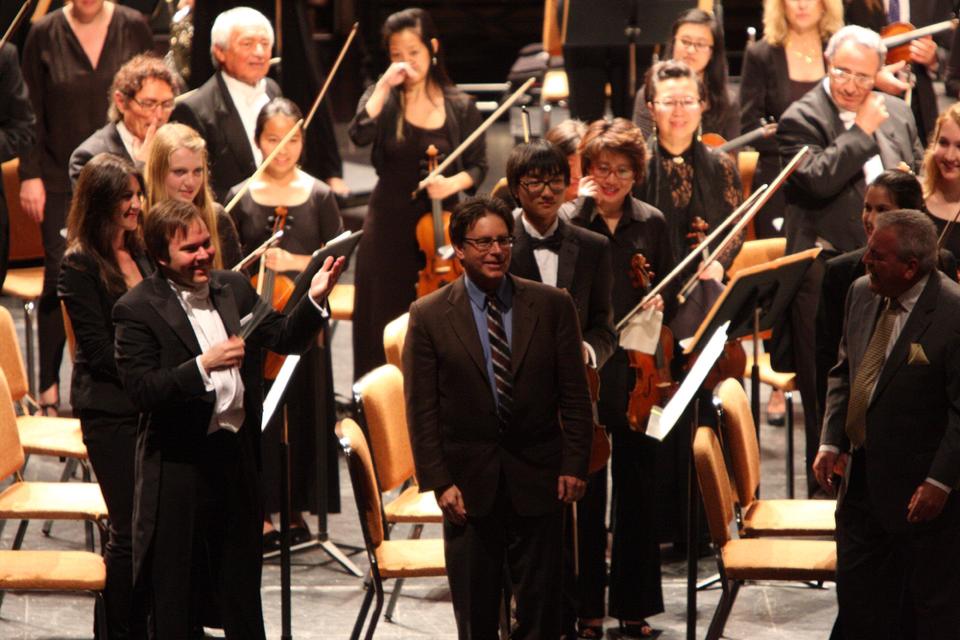
The Los Angeles Youth Orchestra arrived at Carnegie Hall and performed with great passion and dedication. They not only arrived at Carnegie, but as an organization and youth orchestra, they have truly “arrived’. The obvious reason for this event was to give these young players a remarkable opportunity to perform in New York, in one of the great halls of the world. But the other purpose was to show that this organization will be a permanent mainstay in their own community. Clearly, they will be just that.

The students’ training, which involves mentoring with members of major orchestras and rehearsing with professional musicians on a weekly basis, is paying off. The orchestra includes between 80 and 90 students ranging in age from 8-18, from both public and private schools. Although a good percentage of its students do not pursue music as a profession, all of the students’ lives are greatly enhanced through the classics and new music, and they learn life lessons through the program—including giving to and feeling a sense of community, the benefits of teamwork, plus knowledge of history and the arts. Some of their alumni, like violinist Niv Ashkenazi and flutist Elizabeth Erenberg, have decided to enter the music profession, and they joined current members for this Carnegie performance. Ashkenazi joined the orchestra originally as a teenager with the dream of becoming a concert violinist and studying at Juilliard with Itzhak Perlman, and he has fulfilled both those goals. Erenberg is now a successful flutist who recently received her master’s degree from The New England Conservatory, studying with Paula Robison.

The program was dedicated to the memory of the orchestra’s late program director and viola coach, Eve Cohen. In addition, one of the premieres, “EveStar”, by Russell Steinberg, was composed in her honor. Cohen worked with Steinberg to help develop the future of the organization and also to convince violinists to make the relatively seamless switch to the richer, more velvety sound of the viola. The music appropriately concludes with the viola section sustaining a low G string note while violins shimmer and sparkle above–as if to say she has said goodbye but will always remain with the orchestra in spirit. The work is structured so that its sprightly middle section provides a welcome energetic contrast (kids like upbeat tempos)—as if to bask in the many happy memories Cohen provided. This section gives the work real variety, and therefore provides conductors with the opportunity to program a contrasting work that’s both dreamy and animated. No doubt, it is the kind of inspired, catchy piece that deserves many performances. The same can be said for Steinberg’s “Carnegie Overture”, which is naturally celebratory–containing freshly lyrical passages that invite warm feelings–but also pulsating with edgy syncopations and dissonance. The percussion section helps drive the work, which has a real sense of continuity and organic growth from beginning to end. The orchestra played both works with a sense of nostalgia and purpose, with focus and infectious energy. They were well-prepared, performing with rhythmical precision and tonal refinement.

Also on the program was music from Beethoven’s challenging eighth symphony and a welcome, playable William Ryden/ Stephen L. Rosenhaus arrangement of De Falla’s music: a combination of the Miller’s Dance from “The Three Cornered Hat” and the Ritual Fire Dance from “El Amor Brujo”. Steinberg exudes much joy in his conducting, and the players respond with affection and exuberance in return. His interpretations of the Beethoven and De Falla were first rate. I cannot mention everyone here, but the horn and percussion sections were particularly excellent throughout the program, with special kudos to the solo clarinet and solo bassoon players.

Carnegie Hall was packed with a nearly full house, and there was excitement in the air. The Los Angeles Youth Orchestra staff, board and generous supporters are making this orchestra a vital part of the Los Angeles community, and it was wonderful for them and the New York audience that they made such an auspicious Carnegie Hall debut. Russell Steinberg has greatly helped with building this orchestra into an invaluable treasure; a shining and everlasting star.

-Anthony Aibel for New York Concert Review; New York, NY


Los Angeles Youth Orchestra Is Set For Carnegie Hall


The Los Angeles Youth Orchestra has played all over the city, UCLA’s Schoenberg Hall and the Skirball Cultural Center included. But it hasn’t ventured outside of L.A.

Now the orchestra will finally hit the road -- and it’s headed straight to Carnegie Hall.

“Why settle?” says Artistic Director Russell Steinberg.

More than 75 students, ages 8 to 18, will travel to New York for a Feb. 25 concert. The evening is in honor of their late program director and viola coach Eve Cohen, who passed away from cancer last October. Orchestra alumni who worked with Cohen will join the performance.   

Steinberg feels his orchestra is ready to play the big stage. He’s also particularly proud of how diverse the group is.

“I believe we’re the widest geographical youth dispersion of any youth orchestra in L.A.," he says. "We have people from Manhattan Beach and Torrance to downtown L.A. and  Burbank -- any kids who have passion for music. And a lot of our kids are from schools that don’t have music programs.”  

For the New York concert, composer-conductor Steinberg wrote two pieces for the orchestra to premiere: “EveStar,” in Cohen’s memory, and a piece called “Carnegie Overture.” The orchestra will also play Beethoven’s “Plus Symphony No. 8” and “The Miller’s Dance/Ritual Fire Dance” by Manuel de Falla.

The 8 p.m. performance will take place in Carnegie Hall’s main space, Stern Auditorium. The Los Angeles Youth Orchestra has 40 minutes on stage -- half the concert that night. The other half will be  performed by several youth choirs from other parts of the country.

The Youth Orchestra was founded in 1999 with a semester grant from the Jewish Community Foundation. Steinberg has been conductor since day one, when the enterprise was based at Milken Community High School, where he worked; he was music director for the Stephen S. Wise Temple Schools.

By 2003, the orchestra -- then called the Stephen Wise Youth Orchestra -- had become so big, with more than 50 participating schools from all over the city, both public and private, that it was renamed the Los Angeles Youth Orchestra.   

So where does the orchestra go from here, given their first out-of-town appearance is Carnegie Hall?       

“They all retire at age 14,” Steinberg jokes. “No. We hope this will give us visibility. We’ll go for national competitions. And I’m hoping we can branch out right here in L.A. --  doing concerts in different communities."


Youth To Play At Carnegie Hall

Youth to Play at Carnegie Hall

By Libby Motika, Senior Editor

2013-02-21
While the Palisades members of the Los Angeles Youth Orchestra may have different reasons for admiring their conductor and composer Russell Steinberg, they all articulate the conductor/player relationship clearly, respecting Steinberg's unerring devotion to music and strong leadership. 

'Russell is committed to his music and he works to communicate a very specific goal with the passages he is building,' says bassoonist Leland Meade-Miller, a junior at Palisades High. 

For violist Laura Sussman, 'Russell understands the music. Every time we play, he notices new things, making us realize and visualize motives in the music.' 

David Clymer, who plays the trumpet, calls Russell 'a native musician who has a thorough knowledge of the history of music.' Clymer, who is also drawn to composition, enjoys consulting with Steinberg on certain questions, 'so it's a little more personal,' he says.

All three musicians, students at PaliHi, sought to join the orchestra because of its professional standards.

'We practice once a week on Sunday afternoons for four hours,' Sussman says. 'I love it; it's a big chunk of the day, but it's worth it. We play 'real' music. I feel really professional.'

And speaking of professional, the orchestra will perform in Carnegie Hall on February 25 as part of a special concert to honor the late Eve Cohen, who was LAYO's program director and viola coach. 

  When the Los Angeles Youth Orchestra was invited to perform in New York, Steinberg seized on it as an opportunity for the orchestra, but also, secretly, as a hopeful goal for Cohen, who had discovered she had terminal cancer. Adored by all the students and parents, she agreed to play with the orchestra one last time for the Carnegie concert. Cohen didn't make it; she passed away in October. But her dream lives on in the hearts of the 75+ orchestra students who will premiere Steinberg's 'Eve Star' in her memory in Carnegie's main space, Stern Auditorium. 

  The concert will also include Steinberg's 'Carnegie Overture,' Beethoven's 'Symphony No. 8 and 'The Miller's Dance/Ritual Fire Dance,' by Manuel de Falla. 

  Sussman, a sophomore who joined the orchestra this year at the urging of her viola coach Jody Rubin, finds the music relatively challenging. 'The first few weeks, it was horrible,' she says of 'Eve Star,' 'but now we have it. Both pieces are just beautiful. It sounds like you're in heaven.'

  Meade-Miller says, 'The bassoon has some challenging parts and even carries a melody [the bassoon usually plays the lower harmonies] in 'Carnegie Overture.' In 'Eve Star,' the winds emphasize a lighter sense. Bassoons don't always fit into that category.' 

  The trip to New York is purely voluntary, says Clymer, who elected to stay home. 'I am a junior this year, so I thought it better to concentrate on my school work.' Assessing Clymer's busy schedule, one can sympathize with his decision. He belongs to the Colburn School's wind ensemble, PaliHi's jazz band and the advanced orchestra.

  Several orchestra alumni who knew Cohen will be joining the orchestra for the performance at Carnegie Hall. Violinist Niv Ashkenazi was eight years old when he had the dream of studying with Itzhak Perlman. His confinement to a wheelchair with spina bifida never stopped him from achieving. He auditioned for the Los Angeles Youth Orchestra and soon became the concertmaster. He now studies with Perlman at Juilliard and has a major career with performances at the Kennedy Center, Disney Hall and Carnegie Hall.

  Flutist Elizabeth Erenberg was entering middle school when she joined the LAYO. She now has a master's degree in music from the New England Conservatory and performs and teaches in Boston. 

  The Youth Orchestra was founded in 1999 with a semester grant from the Jewish Community Foundation. The orchestra reflects the true diversity of Los Angeles, representing over 60 Los Angeles area schools with children ages 8 to 18 with a wide array of socio-economic, cultural and religious backgrounds. Artistic Director Steinberg is also the L.A. Philharmonic's Upbeat Live lecturer.

Local students to take over Carnegie Hall 

FEBRUARY 17, 2013 7:13 PM


Author:

Mya McCann


COOL KIDS: Students from Santa Monica will be playing with the L.A. Youth Orchestra at Carnegie Hall. (Photo courtesy L.A. Youth Orchestra)

SANTA MONICA — Many musical legends have performed in New York City’s Carnegie Hall over the years. Later this month, 12 students from Santa Monica schools will add their names to that inspirational list.

The Los Angeles Youth Orchestra is hitting the big time. Students from over 60 L.A. schools, ages 8 to 18, are honored with the opportunity to perform a special concert at the historic venue.

“When I realized this was an actual performance, and that the public would be buying tickets to see it, I couldn’t believe it. Some professionals don’t even get to do this,” said 15-year-old oboe player Iden Ameri, a student at Santa Monica High School. “My grandparents would always say ‘my grandson is going to perform at Carnegie Hall.’ They said it in a joking way, but the fact that it’s actually happening is really crazy.”

Composer and conductor, Russell Steinberg, researched tour companies that put on professional concerts and sent out audition tapes of the youth orchestra in action. Manhattan Concert Production received the tape and booked the concert at Carnegie.

“I wanted to create this opportunity for the orchestra. I felt that last year’s orchestra had improved so much and we had never toured before. I had an image of us performing at Carnegie Hall,” Steinberg said.

The students of the orchestra have a long line of music knowledge as some started playing their instruments at a very young age.

“When I was 6, my family and I were on a trip to Ireland, we were on a mountain top and I saw a performer,” 16-year-old New Roads violinist Mica Nafshun-Bone said. “I was amazed by her presence. She was fiddling and I thought it was really impressive so I started begging my mom for a violin and I decided to stick with it … . I’m glad I did.”

The performance in NYC is being held in honor of the orchestra’s late program director and viola coach, Eve Cohen. Cohen passed away from cancer in October but her memory lives on through the 75 orchestra students and alumni who will play together that night.

“Eve was not only my colleague, she was also a fabulous violist,” Steinberg said. “When she passed, I conceived writing a piece especially for her so that she’d be with us.”

Steinberg will premiere his piece “Eve Star” with the orchestra as a tribute to Cohen.

“The piece sounds a little nostalgic and it ends quietly with the violas playing the last note by themselves. I wanted Eve to have the last word,” Steinberg said.

The performance will take place Feb. 25 at 8 p.m. in Carnegie Hall’s main space, Stern Auditorium. The Los Angeles Youth Orchestra is being given half the show, sharing the other half with other youth orchestras from all over the country.

“Being in this orchestra has been an essential step in my musical career… . And since this orchestra goes from ages 8 to 18, I’m probably going to stay until I graduate,” 11-year-old violinist Grace Alexander said. “And most of the kids who are in the orchestra are going to do that. You have to have a real commitment. This is pretty much your whole life and it’s worth it.”

Tickets for this concert are available at carnegiehall.org or at the box office.

The Los Angeles Youth Orchestra will be playing a local concert at UCLA Schoenberg Hall at 4 p.m. on April 14 and at Zipper Hall at The Colburn School in Downtown L.A. at 7:30 p.m. on April 15.

For more information about the Los Angeles Youth Orchestra, visit losangelesyouthorchestra.org.


Strange_Attractors_Article--Breaking_with_Tradition.pdf

Russell Steinberg Awarded Gold Medal Jury's Choice at Park City Film Music Festival (ASCAP announcement)

Radio Interview on Russell Steinberg's STRANGE ATTRACTORS

Martin Perlich interviews Mitchell Newman and Russell Steinberg on their upcoming performance at the Globe in Topanga of Steinberg's Daniel Pearl Tribute: Stories From My Favorite Planet.

Beethoven Strikes Again: Questions for Russell Steinberg

By Cathy Robbins | Posted: Tuesday, July 31, 2007 12:00 am

When La Jolla Music Society’s SummerFest returns for another August filled with great music, a highlight will be a series of three programs featuring music by Beethoven.

So what? For one thing, Beethoven is still in the middle of a global musical winning streak, nearly 200 years after his death. Composer, performer and educator Russell Steinberg will tell us why we still listen in pre-concert talks at the Beethoven programs.

Steinberg’s music has been performed in Los Angeles, Boston, New York, San Francisco, Australia, and Israel. His awards include MacDowell and Aspen Fellowships, and the New World String Quartet competition. Steinberg’s first symphony, CityStrains, was jointly commissioned by the Westchester Symphony in New York and the Hopkins Symphony in Baltimore. Most recently, the Daniel Pearl Foundation commissioned a tribute for violin, piano, and reader titled "Stories From My Favorite Planet." It premiered in October 2003, and because the CD has sold out of print, it will be re-recorded this year.

Steinberg lectures at UCLA and provides some pre-concert talks for the Los Angeles Philharmonic. Steinberg is also the conductor of the Los Angeles Youth Orchestra. He was trained at UCLA, the New England Conservatory and Harvard.

You’ve taught a class titled "Classical vs. Rock Music" for high school students and their parents and UCLA students. Some teenagers first hear Beethoven through Alex, the anti-hero of Anthony Burgess’ novel "A Clockwork Orange" and Stanley Kubrick’s movie adaptation. The Ninth Symphony punctuates Alex’s depraved life of sex, drugs and violence. Does this use Beethoven bother you?

The most disturbing thing about the use of Beethoven in that movie was not Alex’s depraved life but that the music becomes a tool for him to justify evil. The Ninth was intended was as an ode to the brotherhood of all man; it was turned into the music for the greatest evil. It was a brilliant use by Kubrick, and the symphony was done in a synthetic, electronic version. It points out how even today Beethoven is relevant to our lives. I will start the series of pre-concert lectures with the question, "Why are we here listening to music written so long ago?"

Do the three Beethoven programs have a theme or are they just a collection of works the musicians happen to like with catchy titles tacked on for marketing?

I haven’t spoken with the musicians, but looking at the programs, I can say there is nothing casual about the concerts. They’re a little like those Beethoven gave himself. He would do the premiere of the Fifth Symphony with some vocal duets or piano variations —a weighty piece and then salon pieces. The other thing is that the concerts are using chamber music to convey Beethoven’s evolution. There really is a beautiful progression from the Piano Trio to the Archduke Trio. We listen to concerts in isolation and draw conclusions that are either grandiose or not in context with the composer’s entire works. When you hear all the works, you see the connections of ideas.

Beethoven wrote the Piano Trio in E-flat when he was about 23. Who is this guy? What do we hear here that we hear later?

This is a guy who clearly knows and adores Haydn and Mozart. That comes out quickly—the gestures and ease of phrasing, the same grammar of their music. It’s not just imitation; he’s really doing it. What Haydn and Mozart didn’t have, though, are coarseness and syncopation, things stabbing you on the offbeat. Beethoven is reveling in it. You see all the things that will enter his later music. There’s also strong, blocky chordal work and motor rhythms; he gets hold of something and keeps going.

In his early 30s, Beethoven turned to an already well-established form and wrote six string quartets. What did he do differently from Haydn and Mozart, who seemingly perfected the form?

In these early quartets, we see someone who’s dialoguing. You’re going along happily and then things change. The last movement of the early quartet in B-flat that we’ll hear this summer begins with slow chords, then harmonies going off into left field. You sense that Beethoven is trying to get to something deeper than the notes. That’s different from Haydn and Mozart. Beethoven is trying to make a specific statement beyond musical language.

The sonatas for cello and piano were also early works. This combination was experimental. No one had yet written sonatas for cello. Beethoven also had to deal with the technology. The cello’s sound outweighed the somewhat lightweight 18th-century piano he had, so balance was an issue.

So much of Beethoven is about the struggle with the piano, getting sounds we don’t have. We realize that he was aware of the capabilities of the instrument he had and tried to go beyond to get to a sound that just wasn’t possible, even though the notes he wrote were trying to get that sound.

Beethoven was 41 when he wrote the "Archduke" Trio. He was losing his hearing, and his output was slowing down. This trio starts with an incredible melody full of longing that keeps going, through many variations.

What I love is that again everything is going along happily like Mozart and by the fourth measure he does something that sticks out. It’s his way of saying "Pay attention. " That’s one of Beethoven’s thumbprints; he’s always saying "Pay attention." You can’t put this on for dinner music, because it reaches out and grabs you by the lapels. He says this is the most important thing in the universe.

He wrote the B-flat quartet in the years before his death at age 57. This is not nice music. Beethoven makes us squirm. He gives us extra movements, changes tempo constantly, shifts harmonies. What do musicians and composers get from this quartet?

This is the kind of transcendent work we listen to over and over to learn what our art is about. It’s constantly revealing in different layers. The B-flat quartet is also a failed piece. We’ll hear it with the original last movement, the "Grosse Fuge." When it was performed, the publishers told Beethoven that the last movement wasn’t working, so he wrote a much lighter ending and published the "Grosse Fuge" separately. We’ll hear it as it was originally composed and intended. Before that we’ll hear a four-hand transcription for piano. To hear it on piano first will be an extraordinary way to hear the structure. You’ll then be able to hear how Beethoven was straining the string instruments. So much with Beethoven is the sense of the sublime, the sense that he’s trying to take something beyond its capabilities.

What makes the late music so compelling for us today?

This music is eternally modern. It sounds as avant garde today as it did during Beethoven’s time; it continually challenges us as we get absorbed in it. How does it end up getting to these points as the most beautiful ever written?

Beethoven is challenging time itself. He was obsessed with time, with arresting time. Here he’s writing music that goes beyond the conventional western sense of time, ripping the fabric. That’s for listeners. For musicians, we work structurally so deeply that we’re always looking for how something works. The late quartets are the only major pieces Beethoven wrote without commissions; he didn’t care what people thought. He was writing something for himself, trying to find a new synthesis.

You’ve said that while we can sit through a movie that lasts a couple of hours, we start to fidget after ten minutes of a piece of music. That’s because we’ve lost the skills needed to listen to music. What has caused that loss of skills?

I was that person who went to concerts and was bored to death after a few minutes; I became that person who now listens with rapt attention for the whole piece. Much has to do with stimulus, when there’s a change three times a second in a commercial. It leads us to be merely reactive. Active listening is about being proactive, connecting and expecting. When we watch a movie, we’re always expecting. We’ve lost that ability to do this for listening to abstract music.

How do we get it back?

Education is a way to do it. Within three or four classes, UCLA students tell me they’re listening to the music in a different way. It’s almost like rediscovering what you know inside you.

You want to help people listen again through your audio maps, in which you give listeners physical maps of a work like a Beethoven symphony. Give us a couple of those tools for listening but without the maps.

The maps try to get people to listen to music as an unfolding of ideas rather than notes. If you listen to the first five seconds, hold that idea, and follow the entire piece in relation to that idea, you’ll be able to follow the narrative of a whole piece.

Writers have Shakespeare, composers have Beethoven sitting on their shoulders. As a composer what do you whisper to Beethoven on your shoulder?

The danger is what Beethoven whispers to me. Composition is almost a bipolar experience. You have incredible highs and euphoria, and then you hit a place where you can’t put two strings together to save your life. Then you have Beethoven whispering that it’s just not working.

Cathy Robbins is a writer and the author of "All Indians Do Not Live in Teepees (or Casinos)", to be published by the University of Nebraska Press.

CONCERT INFO

La Jolla Music Society’s SummerFest, with 70 artists and 16 programs of music — world, jazz, new and traditional art music — and dance, runs Aug. 3-26 at Sherwood Auditorium, Museum of Contemporary Art/La Jolla and the Stephen and Mary Birch North Park Theatre. Individual tickets $15-$75. The three Beethoven programs are on Aug. 7, 14 and 21, at 7: 30 p..m., all at Sherwood. Steinberg’s talks begin at 6:30 p.m. For more program and ticket information, http://www.ljms.org/.

Ode to Ludwig

Press Release

Monday, May 14, 2007

LOS ANGELES PHILHARMONIC ASSOCIATION PRESENTS FREE NEIGHBORHOOD CHAMBER MUSIC CONCERT AT ST. THOMAS THE APOSTLE CHURCH

Program includes Music of Beethoven, Vivaldi, Mozart, Villa-Lobos and Steinberg

MONDAY, MAY 14 AT 8 PM

Neighborhood Concerts are made possible by the William Randolph Hearst Foundation, Los Angeles Philharmonic Affiliates, MetLife Foundation, David and Linda Shaheen Foundation, the Los Angeles County Arts Commission, and the City of Los Angeles Department of Cultural Affairs.

The Los Angeles Philharmonic Association concludes the 2006/07 Neighborhood Concert series with a free chamber music performance at St. Thomas the Apostle Church on Monday, May 14, at 8 p.m. Los Angeles Philharmonic members Catherine Ransom Karoly, flute; Mitchell Newman and Barry Socher, violins; and cellist Jonathan Karoly perform as part of a program that features Beethoven's "Ode to Joy" from Symphony No. 9; Vivaldi's Allegro from Flute Concerto in D Major, Op. 10 No. 3, "Il Gardellino," Mozart's Flute Quartet in D Major, K. 285; Villa-Lobos' Assobio a jato (Jet Whistle) for flute and cello, and Russell Steinberg's Strange Attractors

Los Angeles Philharmonic members are joined by special guests Renata van der Vyver, principal violist of the USC Thornton Chamber Orchestra, and Susan Rawcliffe, Scott Wilkinson, and Brad Dutz, who perform as Many Axes, a local percussion group that makes its own instruments, in Strange Attractors. Flute students from St. Thomas perform the "Ode to Joy" to open the concert.

St. Thomas the Apostle Church is located in the Pico Union neighborhood of Los Angeles, an area regularly served by the Los Angeles Philharmonic as part of its Community Partnership Project, an outreach program designed to engage local communities with Los Angeles Philharmonic musicians and programs.

Admission to the neighborhood concert is free. More information may be obtained by calling the church at 323.737.3325 or the Los Angeles Philharmonic at 323.850.2000. Free parking is available at 2727 West Pico Blvd. and at the corner of 15th Street and Mariposa. The one-hour concert performance is presented without intermission.

The Los Angeles Philharmonic Association's Neighborhood Concert series, created in 1991, encourages involvement in the classical arts within the increasingly diverse communities of greater Los Angeles. The events take place in churches, schools, and other venues throughout Los Angeles. The Los Angeles Philharmonic Association, under Music Director Esa-Pekka Salonen, presents the finest in orchestral and chamber music, recitals, new music, jazz, world music and holiday concerts at two of the most remarkable places anywhere to experience music - Walt Disney Concert Hall and the Hollywood Bowl. In addition to a 30-week winter subscription season at Walt Disney Concert Hall, the LA Phil presents a 12-week summer festival at the legendary Hollywood Bowl, summer home of the Los Angeles Philharmonic and home of the Hollywood Bowl Orchestra. In fulfilling its commitment to the community, the Association's involvement with Los Angeles extends to educational programs, community concerts and children's programming, ever seeking to provide inspiration and delight to the broadest possible audience.

RUSSELL STEINBERG COMPOSES MUSIC THAT STICKS TO THE RIBS By MELISSA SCRAM Staff Reporter You've driven your commute to work so many times you have it memorized. You can anticipate every bump and dip in the San Diego Freeway. At lunch, the words " Your total comes out to $4.05" make you shudder. And you could draw a detailed map of your route in your sleep. But could you set it to music? " Here all the cars are running down the freeway,"says Russell Steinberg. " The idea is you're cresting over a hill, just before you see a huge gridlock." And the music that has been tumbling from the speakers in his Palisades apartrnent stops. Just for a nano-second. As it continues, Steinberg points out red lights, green lights, passing skyscrapers and the muted cacophony of several car radios in his Symphony #1 "CityStrains." "CityStrains" was commissioned by the Westchester Symphony Orchestra in upstate New York where it debuted in 1998, and was performed again last May by the Hopkins Symphony Orchestra in Baltimore. According to Steinberg , everyone thought it was written about their city. But it's really about LosAngeles, about the strains and stresses of Los Angeles but with a very optimistic energy," he says. "Ironically, I wrote this completely as an LA person and I've never had it performed in Los Angeles." Steinberg, 40, says that he enjoyed working with the conductors and players of both orchestras and that he was able to do more than assume the usual composer position of sitting in the back during rehearsal. "They let me crawl around like a monkey behind the orchestra and suggest things to different players," he says. The third and final movement of the piece contains a car crash in which the percussion section simulates broken glass by pouring nuts, bolts and bottle caps from one metal container to another. A dropped triangle provides the sound of a radiator cap popping off, and a cymbal, thrown on the floor, has the sarne slow, spinning sound as a rolling hubcap. "The whole challenge was could I throw this into a piece and have it fit in," he says. "It all kind of comes out of the harmony." Steinberg is also working on a solo album, called Desert Stars, inspired by Death Valley, which is due out this month. The album contains music for piano and guitar, both instrurnents that he has played since the age of eight, and the main piano piece was premiered at Theatre Palisades. He's planning another concert at Theatre Palisades next year. He has also composed some music for film, and recently completed the music for a documentary on philanthropist and oil tycoon Charles Chapman. In addition, he worked for software companies producing CD-Roms, including one on Strauss and one about the orchestra. Steinberg is looking forward to writing another big orchestra piece,this time about the ocean. He say he tends to gravitate toward themes about the natural world. But now, Steinberg is putting his Symphony #1 on CD in order to market it to other orchestras "It's really important to let the audience out there know what I am doing," says Steinberg, explaining that people are longer being taught how to listen to classical music. 'We live in this world where music, at least classical music, is dying," he says. 'They're listening to "Bach for Breakfast," using; it as background music. But music is something that seizes you by the gut. "If they can't even listen to Be¢thoven's music, how can they listen to my music? How do I convince an orchestra to play my symphony, if they struggle to just to play Beethoven and Brahms?" (continued, right column) What is the solution? "There is no choice but to go through education," he says. Steinberg recently completed his first year as Director of Music at Stephen S. Wise Schools, where he is building a music academy. He taught a class at the school called Rock vs. Classical, which included high school students, their parents and students from UCLA. The students ranged in age from 14 to 65, and debates ranged from Jimi Hendrix vs. Vladimir Horowitz to the Beatles vs. Beethoven. He conducts the Los Angeles Jewish Youth Orchestra, which debuted last year under the sponsorship of the Los Angeles Jewish Orchestra. The youth orchestra is now under the sponsorship of Stephen S. Wise Schools and is open to students from all over Los Angeles. He also teaches extension classes at UCLA, his alma mater. This fall he will teach a class entitled Classical Vienna. "My brothers grew up listening to me play-they couldn't stand it," says Steinberg, referring to his three younger brothers. "It's fascinating and gratifying to me that now they sometimes come to my classes at UCLA. The stuff that I'm involved in is stuff that sticks to your ribs.": Steinberg got his Ph.D in Music Composition from Harvard and also spent two years at the New gngland Conservatory in Boston. He grew up in the North Hollywood and Encino area with his mother, a screenwriter, and his father, an Interior designer. He moved to the Pacific Palisades in 1997. "I had no idea my life would turn this way," he says "I grew up as a valley boy."
By Eric Davis Russell Steinberg spends most of his time nowadays composing for first-rate classical music ensembles. A resident of Pacific Palisades for the past three years, he is currently busy fulfilling his most recent commissions from Los Angeles ensembles and those abroad, most notably from the Westchester Symphony for an orchestral work to be premiered in New York next March. His newest work, a piano quartet, was premiered this weekend by the distinguished chamber music ensemble Pacific Serenades. Entitled "Mulholland Fantasies" and inspired by the myriad vistas found from L.A.'s serpentine mountaintop road, it has remark-able coherence for all of its rapidly shifting diversity of ideas. As Steinberg explains, the entire piece is unified by a single sonori-ty, from which a breathtaking vari-ety of rhythms, moods and textures "spin off." The scoring throughout the 25-minute piece is expert, espe-cially in its understanding of how the instruments communicate with each other. Both the piano and strings (violin, viola, and cello) explore a multitude of fresh combinations, creating with each a unique musical vantage point on the same essential materials. (continued, right column) And yet, Steinberg is not loath to tradition. In "Mulholland Fantasies," the composer is unabashed in acknowledging Brahms as "an inspiration". He substan-tiates this claim, particularly in the final movement, with an abundance of rich, lyrical counterpoint in long, luxurious allegros which do just homage to the old master. Rhythm clearly plays a critical role in Steinberg's musical language. Even at his most aggressive, he seems to take joy in creating rhythm rather than in trying to defeat it. His sense of motion has sweep, and is not fragmented by the many natural interruptions and changes of pace that occur, all which contribute to the larger motive of their given movement and of the entire piece. While Steinberg may still be considered a young composer at 37, he has an impressive list of accomplishments to his credit . His s awards include an ASCAP Young Composers Grant, MacDowell and Aspen Fellowships, and First Prize in the New World String Quartet competition. He holds a Ph.D in Music from Harvard University where he studied with Pulitzer Prize winning composer Leon Kirchner.
October 22, 1983 PIANO TRIO Emotional impact was certainly the overriding thrust of Russell Steinberg's 20 minute piano trio, a work striking for its dramatic amalgram of sweeping romantic melodies with a mixture of traditional diatonic harmonies and ones that are quartal (constructed with chords of fourths rather than thirds). Though Steinberg's music lacks truly memorable material, structural tightness, and rhythmic intensity (even the Allegro molto seems an andante at heart), his communicative flair shines through any shortcomings. His development bears watching. February 17, 1984 SONATA FOR VIOLIN AND PIANO To be present was to be reminded again that today's music speaks in many different voices, some of them intent on sounding like yesterday's. Russell Steinberg's lush and warmly romantic Violin Sonata could have come right out of the mid to late-19th century; its expressive vocabulary, which manages to avoid anachornism or camp, might have appealed to such virtuosi as Jan Kubelik or Eugene Ysaye. In its quite different, ornate and witty way, Steinberg's Fanfare for three trumpets seemed the product of a lively sensibility also. October 12, 1984 RHAPSODY FOR VIOLIN AND PIANO Russell Steinberg's Rhapsody for Violin and Piano, though it was instrumentally grateful also, wearied on in a neo-Romantic idiom; it wasn't tasteless, but at Warner Brothers (whose musical predilections it did evoke) a lot of it would have wound up on the cutting-room floor. February 27, 1989 "WHITE CRANE STUDY" Russell Steinberg's "White Crane Study for Soilo Violin" is expertly conceived for the instrument and has some perky charm. However, except for its effective evocations of crane calls, it reminded me of the solo violin sonatas by the turn-of-the-century Belgian virtuoso Ysaye. June 20, 1989 SEQUOIA, PIANO SONATA Steinberg's Piano Sonata had some of the same musculature as the big Romantic concertos, but with nothing "neo" or meretricious about it. To these ears the floating, luminous music of the middle movement was also the heart of the piece. CLARINET TRIO In his Clarinet Trio, Russell Steinberg appropriates with youthful exuberance the idioms of Stravinsky and Schoenberg, but in a way that seems personal and honest. His piano writing, with its spirals of high notes and colorful trills, is deft, as was the performance by Ian Greitzer, Michael Curry and Kathleen Supove. SHORT DESCRIPTIONS OF RUSSELL STEINBERG'S MUSIC: Emotional impact a work striking for its dramatic amalgram of sweeping romantic melodies his communicative flair shines through His development bears watching. lush and warmly romantic expressive vocabulary, which manages to avoid anachornism or camp different, ornate and witty way the product of a lively sensibility expertly conceived for the instrument and has some perky charm effective evocations the same musculature as the big Romantic concertos, but with nothing "neo" or meretricious about it floating, luminous music youthful exuberance in a way that seems personal and honest piano writing is deft eclectic and fanciful

Video of interview:

Join Mark O'Connor, Paul Schoenfield and George Tsontakis - three outstanding American composers whose works were featured in SummerFest 2009 - as they exchange ideas in a roundtable discussion moderated by composer and conductor Russell Steinberg. (#17206)


It was February 1, 2002, when 38-year-old Daniel Pearl looked into the camera of his captors and spoke his last words. My name is Daniel Pearl. I am a Jewish American from Encino, California USA...My father's Jewish, my mother's Jewish, I'm Jewish… Pearl, The Wall Street Journal's South Asia bureau chief, was on his way to interview a Muslim fundamentalist leader when he was captured and beheaded by terrorists in Pakistan. His abductors brutally ended the life of a passionate journalist, a gifted musician and a loving man. Yes, we know Daniel Pearl because of how he died as a valiant reporter, but his true legacy is in how he lived—through music, through family and through Judaism. In honor of their son, Judea and Ruth Pearl established the Daniel Pearl Foundation and World Music Days in 2002, aiming to counter the hatred and intolerance that took his life. World Music Days is an international network of concerts in October striving to reaffirm a commitment to tolerance and humanity. The 2010 World Music Days coincides with what would have been Pearl's 47th birthday on Oct. 10. This year, more than 1,000 concerts in the United States, 34 in Israel, 27 in Malaysia, 17 in China, one in Iceland and performances in Muslim countries will dedicate their music to the theme of harmony for humanity. On Tuesday night, the Jewish Music Commission (http://jewishmusicla.org/) of Los Angeles and Valley Beth Shalom (/listings/valley-beth-shalom)presented "Stories From My Favorite Planet," a musical tribute to Pearl in his hometown of Encino. Composer Rwould have been Pearl's 47th birthday on Oct. 10. This year, more than 1,000 concerts in the United States, 34 in Israel, 27 in Malaysia, 17 in China, one in Iceland and performances in Muslim countries will dedicate their music to the theme of harmony for humanity. On Tuesday night, the Jewish Music Commission (http://jewishmusicla.org/) of Los Angeles and Valley Beth Shalom (/listings/valley-beth-shalom)presented "Stories From My Favorite Planet," a musical tribute to Pearl in his hometown of Encino. Composer Russell Steinberg and Los Angeles Philharmonic violinist Mitchell Newman collaborated on the original piece, which premiered in October 2003. The Genesis It was 11 p.m. when Steinberg called Daniel Pearl's father, Judea. He said he was a composer and would like to meet with him. Without delay, Judea told him to head over. Late that night in 2003, Steinberg arrived at the Pearls' Encino home with his proposition for a music piece: five of Danny's newspaper articles to evoke the journey of his career, each accompanied by music to provide an emotional context. "I had no idea what to expect from this young composer who just called and dropped in," Pearl's soft- spoken mother, Ruth, said. "By the end of the evening, we decided that we were going to go for it." "We laughed the whole time," said Steinberg thinking back on that night. "So I said if I was going to write a piece it couldn't be a downer. This was about a person who just celebrated life to the tips of his toes and I wanted to incorporate some of that humor." Ruth then called Newman, whose wife dated Danny in high school, to see if he'd be the violinist for the piece. "Right then, we had a done deal all wrapped up in one visit," she said. The Pearls sent Steinberg home with a copy of At Home in the World: Collected Writings, a book of their son's writings. He read through more than 200 of Pearl's articles and was struck by the quirkiness and humor weaved throughout his writing. "I had already known that both of us grew up in Encino and attended Birmingham High School," Steinberg said. "What I didn't know was that Danny himself was an accomplished violinist and that his passion to play music helped him establish networks of friends wherever he went." Pearl was a classically trained violinist, a fiddler and a mandolin player. When he lived in Washington, D.C., he jammed around the bars in Adams-Morgan. When his career took him to India, he played regularly with local bands in Mumbai café-bars. Pearl carried an instrument with him wherever he went, until his assignment in Pakistan and his tragic death. With each performance, Steinberg and Newman bring Pearl's spirit back to life, reflecting the warmth and appreciation he had for the world around him. "Stories From My Favorite Planet" is full of humor and irony, poetry and sadness. "It's a different slice of the new music pie than we play at the Philharmonic or Disney Hall," Newman said. "Danny's words are as great a piece of music as anything." "Stories From My Favorite Planet" Steinberg read each of Pearl's articles, and with Ruth and Judea's permission, edited five of them for length. The stories he chose illustrate the diversity in Pearl's writing style. One minute he makes you laugh, and the next he sends chills down your spine. With a pen and piano Steinberg began composing an equally riveting arrangement. Throughout the 45-minute composition, Steinberg and Newman alternate between reading Pearl's articles aloud and playing the corresponding music. "Stories From My Favorite Planet" begins with Pearl's hilarious indictment against the bureaucracy of the Registry of Motor Vehicles. The music, playful and skittish, reflects the bureaucratic red tape Pearl describes. "Next is a powerful story set in Kosovo where Pearl tries to discover if any Serb and Albanian friendships still remain amidst war," Steinberg said. Pearl's article titled "Search for Mercy Ends in Tears on Quiet Kosovo Street dovetailed with a melancholy violin and piano duet. The piece then moves to one of Pearl's most humorous articles about a stolen Stradivarius violin. Steinberg and Newman capture Pearl's brilliant sarcasm with a tango oeuvre. The mood quickly turns as Steinberg reads one of Pearl's darkest stories concerning Osama bin Laden's gem smuggling trade in Africa. Here Pearl discovers how passionately Islamic fundamentalists want to kill Americans, eerily foreshadowing his own fate. The vigorous musical tarantella flawlessly reflects the piece. The audience is finally faced with Pearl's tragic murder. His obituary is read aloud, followed by a musical elegy. "There was no way I was going to end this piece on a depressed note," Steinberg said. "Danny Pearl's wit would not stand for it!" The piece comes full circle with a sequel to the first article in which Pearl gloats that he has outlasted the last chief of the Registry of Motor Vehicles. Pearl's words bring a smile to the audience, as the music echoes his energetic spirit. With a standing ovation, the audience applauded Steinberg, Newman and the late Daniel Pearl. From Strangers to Family After eight years of performing "Stories From My Favorite Planet" in Pearl's honor, Newman and Steinberg have grown close to Pearl's parents. What started as a vision late one night became an unforgettable musical tribute. Ruth attended the event at Valley Beth Shalom, embracing the men with a hug and an approving, "thank you, thank you so much." Judea could not attend because he had a prior commitment in Michigan, but he was the one who came up with the title, "Stories From My Favorite Planet." Ruth spoke at the concert for the both of them. "Your music will serve a purpose for it will blend with the sounds of hundreds perhaps thousands of concerts around the world this month begging the earth for sanity and humanity," she said. "Your music today will resonate in defiance over the forces of hatred that took our son's life. And it will reinforce our unshaken conviction that at the end of the day music will triumph and humanity will prevail. United, we are making a difference." "Danny traveled the world with a pen and a fiddle, connecting people through words and music," Ruth continued. "Today he is watching your stage and hundreds like it with a smile and wonder of the global symphony that his journey has inspired. His fiddle was not silenced." For more information, visit the Daniel Pearl Foundation website (http://danielpearl.org/). Audio CDs of "Stories From My Favorite Planet" are available there.