Schubert's Brook of Innocence (Die Schöne Müllerin)
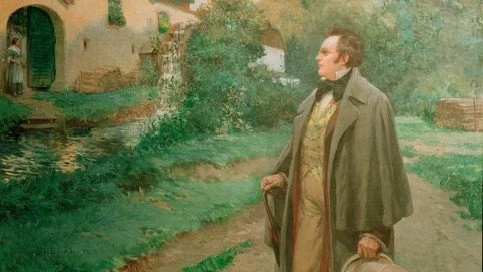
I’m thinking about pop songs that are deeply moving and profound—The Beatles A Day in the Life, George Harrison’s Something, Bob Dylan’s Tangled Up In Blue, Leonard Cohen’s Suzanne, etc. And I’m asking myself, how is it that a bunch of songs about a silly boy singing to a brook about his unrequited love for a miller’s daughter has me more emotionally overwrought than ANY of those other songs? The final song of the cycle, The Brook’s Lullaby, won’t stop echoing in my head. Relentless. And it’s inhabiting a deeper place in my heart than I could have possibly imagined.
The Brook’s Lullaby (Des Baches Wiegenlied)—the final song of Die Schöne Müllerin)
Schubert wrote this cycle of 20 songs when he was about the same age these pop legends were when they wrote their hits—mid 20s. But then again, let’s remember that he was, after all, Schubert, the guy who wrote The Erl King (Erlkönig) and Gretchen at the Spinning Wheel (Gretchen am Spinnrade) in his teens.. Plus he composed Die Schöne Müllerin a year after contracting syphilis, an all but certain death sentence in the early 19th century, so he wasn’t in a trivial emotional space.
And here’s the thing: no single song in Die Schöne Müllerin is really a “hit.” It’s in the accumulation of the entire journey that something deep begins to grow, out of the interconnectedness of one song to the other. We sense organic cohesion, but it adheres and develops in a very different way from that of Beethoven on the one end or The Beatles on another. The realization gradually dawns on us that each song is a psychological waypoint in our own lives.
Schubert set this collection of poems by his friend Wilhelm Müller, the same poet who wrote Die Winterreise, Schubert’s ultimate masterwork. And the seeds for the Winter’s Journey are found deep in this earlier work. In fact, the drone progression in The Miller and The Brook—Der Müller und der Bach—bears an unmistakable similarity to The Organgrinder (Der Leiermann), that devastating and unforgettable finale of Die Winterreise. Only instead of trudging through the snow towards wintry death, we here follow a beautiful babbling brook through a heartbreaking romantic journey.
The story is ridiculous: a young journeyman miller follows a brook to a mill where he starts to work and fall in love with the miller's daughter. His romance is all internal projection. In fact, he barely talks with her at all. Sitting together outside one night, while he expounds on the beauty of the moon and stars, she remarks the rain is coming and goes back home! His hopes are finally dashed when the girl falls for a visiting hunter.
Our hero’s actual relationship is not with the girl at all, but with the babbling brook that is his constant and only companion. The brook is the life force that sustains him, that brought him to the mill where he imagined working and building a life and love. The brook listens to his arduous passion and imagined romance. The brook comforts him through rejection, rage, and grief. And at last, the brook lulls him to suicide.
Here are all the essential ingredients of the Romantic era: nature in all its beauty and mystery, unrequited love, intense emotions, and a quest for the sublime. This song cycle is a meditation on hope, innocence, beauty, and inconsolable loss. I urge that we discard a literal reading, that the young man commits bodily suicide. I think it’s clear the suicide is psychic, a letting go of our innocence. It’s too much a story we all share. The young miller is all of us remembering our youthful idealism, our youthful romantic passion for the perfect “other,” our youthful self-absorption and self-importance, our projection of desire on a person we never get to know, our youthful naivety, our youthful belief in nature’s perfect plan for us…and remembering the moment it all came crashing down when reality intruded on all of that internal dialogue. And we, painfully, became adults.
Of course it is Schubert’s music, and specifically his accompaniments, that lift this story into the mythic realm. The entire song cycle is immersed in the brook, embodied in the piano. The very opening song Wandering (Das Wandern) is accompanied with churning arpeggios that alternate simply between tonic and dominant chords to represent the turning wheel of the mill.
The very next song, Wohin (Where to) introduces the brook itself as a character with a rippling arpeggio accompaniment.
And at some point in almost every song, that brook reappears with its bubbling arpeggios, either serene or energetic.
The brook takes him to the mill, again with rippling accompaniment:
A similar vigorous and “watery” accompaniment to the opening song captures the exuberance of feeling in love in the song Mein! (Mine!):
The brook even makes a heartbreaking entrance in Tears of Rain (Thränenregen) when the young miller, immersed hopeless in complete internal fantasy, sits with the miller’s daughter one evening as they look down at the brook:.
No single song accomplishes the emotional catharsis. Rather, all 20 together accumulate into a deep overwhelming emotion of inconsolable loss, of love and innocence, fantasy, and idealism, loss culminating in the final lullaby of the brook, where the water’s arpeggios gentle rock the young man to his final slumber. Schubert’s heavenly drones float above and below the singer. We lie immersed in the brook with the miller boy, drowning tragically, drowning blissfully within those watery drones. This is the Romantic sublime that lifts Schubert’s songs to a deeper order than all these other great songs of our time that we so love.